Monday, 23 January 2017

Day 7 - Summary: Behavior Gap, Greed and Fear and Disposition Effect.

On Day 7 today I am going to go over all that I have covered in the last six days. Not just for your benefit but also for mine. 

I have to keep reinforcing these principles day after day, week after week and month after month. And sometimes I slip but as long as I avoid large errors of commission and make some errors of omission, I am going to be fine. 

My goal is to survive and position my self to take advantage of the big move "when" it comes. There is no question of "If". As a famous trader said, "There are bold traders and there are old traders. But there are no bold old traders".

Day 1: I wrote about the Behavior Gap. Most investors when they turn over their investments to a money manager or a mutual fund manager are not happy with market returns. But what they should be keeping in mind is whether their manager is doing a better job than what they would be doing with their own money. If he is, then half the battle is won. 


Day 2: I wrote about how most media and any one who tries to forecast markets almost always gets it wrong. Most major market turns have been made when a major business/non business magazine has made a major prediction about the direction of markets on their cover page. 


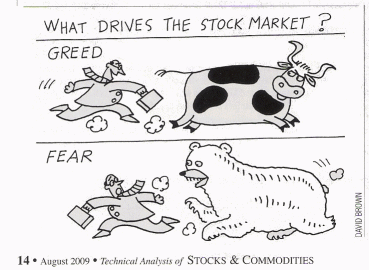
Day 3: I wrote about how bubbles are formed. In times of extreme euphoria when a good premise is taken too far and when investment action is driven solely by prices and leads to too much easy money flowing into markets. It is then that a bubble is formed. No one can predict when or how a bubble will burst. As Keynes famously said, "Markets can remain irrational far longer than you can remain solvent". Two basic primal emotions drive markets: Greed and Fear.


Day 4: I wrote about a particular phenomenon called the Disposition Effect: Holding on to losers for too long and selling winners early. Everyone makes this error and the important thing is to be aware of this behavioral bias. 

Day 5: I wrote about Warren Buffet's most famous self admitted error: Buying Berkshire Hathaway when it was a slowly dying textile business. Buffett converted it into an investing vehicle to take advantage of losses and in time added an insurance business to it. 

Day 6: I put my self out there and shared with you an exercise that I carried out when I checked up my own portfolio a few years ago and the impact that Disposition Effect was having on my returns. 


ET reported that Disposition Effect and overconfidence resulted in Indian retail investors losing Rs. 8,376 crs between January 2005 and June 2006 as per a study conducted by Prof Sankar De and his team at Indian School of Business. The total number of investors who traded at least once between January 2005 and June 2006 stood at 25 lakh. If one mirrors a secular trend over the years, the total losses for Indian individual investors would be around Rs 20,700 crore or Rs 82,800 per active investor per year.

And please contribute to my fund raising campaign for the Nudge Foundation.

Regards
Anish


Sunday, 22 January 2017

Day 6 - Understanding Greed and Fear

I want to start off by thanking all of you for reading my blog and for contributing to my campaign to raise funds for The Nudge Foundation. I have reached 20% of my target in six days and I am sure that I will reach my target soon. 

Today I am going to talk about how I discovered what my disposition effect was costing me. Just to remind you: Disposition effect is holding on your losing positions and selling winners early.

In 2011-12 when I was evaluating my portfolio I did an exercise. I examined the list of stocks and I found a pattern. I had belief that a long term investor doesnt sell easily and consequently held on to positions for way too long. 

Below is a list of stocks which were losers. I have assumed an equal position size. And the loss I booked when I sold and the loss I would have suffered if I had sold them when they went down 10%. And in the third column, CMP, is the market price when I carried out the exercise in 2013 ( am not sure of the exact month).


I sold the stocks at 39% loss but if I had held on to them I would be sitting on a 62% loss. 

Given below is a list of winners. These stocks did not dip by more than 10% from my time of purchase. This table shows that profits take care of themselves. The average gain on winner portfolio was 75.6%.


And then I put the the winner and loser portfolio together see how much the portfolio makes on average in three scenarios. The first scenario is the actual scenario, the second scenario is the one in which I cut losers if they fall 10% and in the third scenario if I continued to hold on to them.


In the scenario where I sold stocks where I did, I ended up with a respectable 18.3%. But if I had continued to hold on to the stocks for another 6-12 months my returns from the portfolio would have fallen to 6.8% : a return below FD returns. But the big stunner was the portfolio return of 32.8%  if I had sold my loser stocks when they fell by 10%. 

And now whenever I try to hold on to losers for too long this table comes to my mind. The 10% Stop Loss is not sacrosanct. Some small/mid caps may fall even further before moving up and so a differential Stop Loss number has to be used of large, mid and small caps. This blog was more to illustrate how important it is to recognize that if a stock you have bought has gone then you have got one of two things wrong : either you picked the wrong stock or you got the entry time wrong. Either ways you were wrong. Good and strong stocks usually take off immediately. 

I would encourage and urge all of you to do this exercise for your own portfolio. It may turn out be an eye opening moment and change your investment portfolio returns.

All the best. Please support the Nudge Foundation. They are doing a wonderful job. You can donate here. No amount is too small or big. Your participation will give the foundation and me a lot of joy and encouragement.

Regards
Anish


Important Disclaimer: Please do not treat anything on my blog as investment advice. I do not provide any recommendations of any stocks or securities. Any stock mentioned may be merely by way of an example.


Saturday, 21 January 2017

Day 5 - Understanding Greed and Fear

Yesterday I wrote about Disposition Effect: Holding on to losers and selling winners too soon. I give below a true example of how Buffett made this mistake but ultimately turned the investment around.

It would come as surprise to many that one of the most valuable companies in the world Berkshire Hathaway owned by the most successful investors of all time Warren Buffett, was actually a lemon as an investment when it was originally made. 

Warren Buffett began buying shares in Berkshire Hathaway on December 12, 1962 at $7.50 a share. His initial intention was to flip his shares for a relatively quick profit but changed his mind after having some problems with Berkshire’s president, Seabury Stanton, and ultimately bought enough Berkshire stock to control the company. Buffett’s investment in Berkshire Hathaway would go down as arguably the worst investment of his career.

Why?
  • Berkshire Hathaway was undervalued for the wrong reasons; nine years of losses and had closed more than a dozen textile plants over the previous decade.
  • The textile business in the US at that time was not a good business and was going downhill; to a significant part as a result of foreign competition, which was squeezing profit margins to the point of no return.
  • Berkshire’s financial position was unlikely to improve.
He would later explain: “So I bought my cigar butt, and I tried to smoke it. You walk down the street, and you see a cigar butt, and it’s soggy and disgusting and repels you, but it’s free, and there may be one puff left in it. Berkshire didn’t have any more puffs. So all you had was a soggy cigar butt in your mouth. That was Berkshire Hathaway in 1965. I had a lot of money tied up in the cigar butt. I would have been better off if I’d never heard of Berkshire Hathaway.”


Buffett being Buffett turned Berkshire into a vehicle for making future investments and ultimately made it to a big winner. But there is only one Buffett and then there are the rest 99.9%.

So for the rest of us it is best to get out of losers early.

Tomorrow I will talk about my own follies. 

All the best. Please support the Nudge Foundation. They are doing a wonderful job. You can donate here. No amount is too small or big. Your participation will give the foundation and me a lot of joy and encouragement.

Regards
Anish


Important Disclaimer: Please do not treat anything on my blog as investment advice. I do not provide any recommendations of any stocks or securities. Any stock mentioned may be merely by way of an example.

Related Links

Friday, 20 January 2017

Day 4 - Understanding Greed and Fear

It turns out that there are specific names for the behavioural patterns that I have described in my earlier blog which you can read here.  Over the next four days I am going to break down greed and fear into four specific behavior patterns which are also called behavioral biases.

The very first one is something we have all experienced and are guilty of. Everyone from Warren Buffett to a first time investor makes this. Holding on losers for too long and selling our winners early. Whereas we should be doing the opposite. 

Why do we do that? We do it because we hate to accept our mistakes and a loss isnt a loss until you sell the stock. And we will do everything we can to put that away. And we keep hoping and hoping that a stock that we have bought and has gone into a loss, will atleast come back to break even. Sometimes it does and we hold on to that memory and forget that most of the times it does not. But humans have survived on hope and optimism but that does not work well in the stock market. 

And why do we sell our winners early. Because we want to feel good and stoke our ego. We want to feel warm and fuzzy in our heart by seeing a winner in our portfolio and we want to lock that moment in. Fear of giving back profits sets in as soon as a stock goes into profit and every down tick is painful.

A stock owner goes through myriad emotions as price moves. The picture below illustrates this.

And it turns out that there is specfic name for this behavior pattern and its called the Disposition EffectResearchers have traced the cause of the disposition effect to so-called "prospect theory", which was first identified and named by Daniel Kahneman and Amos Tversky in 1979. Kahneman and Tversky stated that, "losses have more emotional impact than an equivalent amount of gains," and that people consequently base their decisions not on perceived losses but on perceived gains.

What this simply means that losing Rs. 100 gives us more pain than the joy of gaining Rs. 100. It turns out that it takes twice the amount of gains i.e. Rs. 200 in the above example to offset the loss of losing Rs. 100.  

And this happens to the best of investors. So know that when you fall prey to this behavior, you are not alone. But it so happens that you can train yourself to over come this or check youself when you become aware that you might be making this mistake.

Remember, it is not wrong to make a mistake, it is however wrong to continue holding that mistake and not taking action. 

A simple rule to follow for your monthly/quarterly portfolio review would be: Keep winners, discard losers. 

In my later posts I will be more specific about how to identify a stock has become a loser. 

And with that let us welcome the 45th President of the USA. Donald J. Trump. 

All the best. Please support the Nudge Foundation. They are doing a wonderful job. You can donate here. No amount is too small or big. Your participation will give the foundation and me a lot of joy and encouragement.

Regards

Anish


Important Disclaimer: Please do not treat anything on my blog as investment advice. I do not provide any recommendations of any stocks or securities. Any stock mentioned may be merely by way of an example.


Thursday, 19 January 2017

Day 3 - Greed and Fear - Making of a Bubble

Day 3 - Greed and Fear

The two most basic instincts of humans from the days of Adam and Eve. Adam was greedy and got tempted by the apple. And then fearful because he knew he would have to pay for his greed. 

These are our primal emotions. So then how do we get over them ? Each of us is emotionally wired differently. But as a crowd or mob our reactions are pretty much the same. I have a quote in my office by Charles McKay that says "Men think in herds, they go mad in herds. While they recover their senses, one by one."

And this is true from the 17th Century Tulip mania right down to the 2008 housing finance crisis. 

Now you may ask why does this cycle repeat itself when it is so evident. It repeats itself because with each cohort of older investors exiting the market, either because they have run out of financial or emotional capital or have passed away, a new set of younger investors enter the market. And these investors do not learn from the mistakes of the older generation because human beings like making their own mistakes. 

Now the name of the crisis or bubble may be different but the basic structure of a complete market cycle remains the same. Look at sketch below by Behavior Gap's Carl Richards. You can put the name of tulip mania, or gold rush, 1929 Great Depression, 1987 October Crash, the dot com bubble or the housing bubble or take your pick. It all fits into this one sketch.


And who better to illustrate this point with an example than Warren Buffett. In his testimony to the Financial Crisis Inquiry Commission he was asked. I have extracted this from an article in Fortune which you can read here

Brad Bondi [financial crisis inquiry commission]: What do you think it was, if you were to point to one of the single driving causes behind this bubble? What would you say?

Warren Buffett: My former boss, Ben Graham, made an observation, 50 or so years ago to me and he said, “You can get in a whole lot more trouble in investing with a sound premise than with a false premise.”

After a while, the original premise, which becomes sort of the impetus for what later turns out to be a bubble is forgotten and the price action takes over. The price action takes over because people have forgotten the limitations of the original premise.

Now, we saw the same thing in housing. So this sound premise that it’s a good idea to buy a house this year because it’s probably going to cost more next year and you’re going to want a home, and the fact that you can finance it gets distorted over time if housing prices are going up 10 percent a year and inflation is a couple percent a year. Soon the price action -– or at some point the price action takes over. And once that gathers momentum and it gets reinforced by price action and the original premise is forgotten.

And the price action becomes so important to people that it takes over the—it takes over their minds, and because housing was the largest single asset, around $22 trillion. Such a huge asset. So understandable to the public—they might not understand stocks, they might not understand tulip bulbs, but they understood houses and they wanted to buy one anyway and the financing, and you could leverage up to the sky, it created a bubble like we’ve never seen.

The Internet was the same thing. The Internet was going to change our lives. But it didn’t mean that every company was worth $50 billion that could dream up a prospectus.

To summarise what is written above, incase you found it too long, Buffett is saying that the housing market demand was driven by a sound reason to buy a home because over a period or time it costs more to buy a home and if you are going to buy a home to reside in it then it better to buy early than later. However, as time passed genuine demand for housing began to taper off, but the supply of financing continued to be strong. And this caused housing prices to go up and at some time buyers were buying homes not because they wanted to stay in those homes but because prices were increasing at a rapid pace and cheap financing was available. And a sound investment premise became a bubble. The crossover point is known to none. And that's what makes it a market. 

No one is going to ring a bell at the bottom or the top of a market cycle because no one knows precisely where the market is going to make a top or bottom. But if you observe in a somewhat detached manner, you will know that what is going on does not make sense. But because we all suffer from FOMO (Fear of Missing Out), we jump in.

Tomorrow we will see what we can do to manage these two emotions. 

Wednesday, 18 January 2017

Day 2 - Magazine Covers and Financial Markets

Day 2 - Magazine Covers and Financial Markets

So yesterday I signed off saying that you should follow your investing plan and not focus on external events. Here is the link to yesterday's blog in case you have not read it.

Now when I say you should not focus on external events, it does not mean that you should go and live in a cave and shut yourself from the rest of world, because that is only way you will be able to escape all the noise in media. It means that you need to control Greed and Fear: the two emotions that strike you when processing such noise.

I am going to use magazine covers which would widely cover and try to predict the impact of different social, economic or political events on the stock market. So today is going to be more of images and pictures.

Now let us go back to 1979 and look at the cover of BusinessWeek on Aug 12th.


This was one of the most bearish articles on the equity markets ever. It made the point how the US economy was in the grip of inflation and equities were dead as an asset class. Now what happened after that was that the market made its all time low on Aug 13 1979 and never ever visited that price. And not only that, the S&P went up more than 13x over the next 20 years after that cover. And the same thing happened in 2002. Another bearish cover was published by Businessweek and another low was made by markets post which they doubled over the next 6 years.

And then Time Magazine said we won’t be left behind and they published a very positive article in 2005 on housing in America and we all know what happened after that. If you don’t know then you should watch this movie called "The Big Short" based on a book of the same name by Michael Lewis.


Below is an example from Indian media. In November 2008, the month that Business Today came with a cover story on the Great Financial Crisis, Indian equity markets made a low and took off again.


In fact Princeton economist Paul Krugman once stated that for “whom the Gods would destroy would first put on the cover of Business Week”.

Now you may think these are cherry picked examples and hence I ask you to do a fun exercise. Go back and look at cover stories of big events and predictions made by magazines and electronic media of those on the markets and then look at performance of the market post that. 

It is not about pointing fingers at the media, but more to illustrate the point that no one can predict what effect will any event have on markets. 

In recent times we have had two big events last year. Brexit and the election of Donald Trump. Both were considered to be very bearish and catastrophic events by the media. And see how markets reacted. The British FTSE is up a massive 17.6% since Brexit and the US Dow is up 8.1% post Trump's victory on November 8 2016. So it is futile to go by media or anyone’s predictions of how markets will perform. 

With this I end today’s blog and let you think about the magazine cover below which is the current issue of Business India.


There are some links below if you want to read more about the so called Magazine Cover Indicators or the Curse of Magazine Covers. 

All the best. Please support the Nudge Foundation. They are doing a wonderful job. You can donate here. No amount is too small or big. Your participation will give the foundation and me a lot of joy and encouragement.


Regards
Anish


  1. Are magazine covers a contrarian indicator?
  2. The Curse Of The Magazine Cover Indicator
  3. Misunderstanding the Magazine Cover Indicator 

Tuesday, 17 January 2017

Day 1 - Introducing "Behavior Gap"

My blogs over the next 21 days will cover important elements about investment behavior and issues for investors in their 20s and early 30s. I really wish I had known all this early in my career. Whenever I refer to investors in my writing, it will be assumed to be the average retail investor and not full time/professional investors, unless otherwise specified.

Today I will be explaining in very simple terms what the term "Behavior Gap" means and why it is so important for all investors to be aware of this.

A few years ago I came across the DALBAR's Quantitative Analysis of Investor Behavior (QAIB). DALBAR is a US based firm formed in 1976, which provides evaluation of investment companies, RIAs, broker dealers etc. They have been studying investor behavior for a while now now and keep updating their study every year. One of the key findings of this study is that an average investor under performs the popular benchmarks by a significant gap. This under performance or gap by an average retail investor is what is called "Behavior Gap". 

It is called "Behavior Gap" because DALBAR discovered that 50% of the under performance arises due to "Voluntary investor behavior" which is the investing equivalent of an "unforced error" in tennis. Voluntary investor behavior generally represents panic selling, excessively exuberant buying and attempts at market timing

The graphic below shows the gap between the average stock fund return and the actual return of an average stock fund investor over 20 years. 


This is an extremely important insight. That almost half the gap can be bridged by modifying our own behavior. This means no blaming the market, advisors, or complaining that the market is rigged. You cant play the victim. Because you have met the enemy. And it is you.

Are you ready for the journey where over 20-30 years you will face many world changing events, many financial crises, Prime Ministers and Presidents will come and go, economies will rise and fall and so on. But you will ignore the noise and continue to diligently follow your investing plan. You will not get carried away by a rising market or be overly despondent if the market falls. You will not be lulled into boredom when the market does nothing. Or will you make "unforced errors" ?

Come to think of it, do you change your diet plan or exercise routine based on external factors or do you change it or follow it based on what works for you? You may say that this is not correct and that external events do affect the stock market and prices. For this read my Day 2 blog. 

All the best. Please support the Nudge Foundation. They are doing a wonderful job. You can donate here. No amount is too small or big. Your participation will give the foundation and me a lot of joy and encouragement.

Regards
Anish

Important Disclaimer: Please do not treat anything on my blog as investment advice. I do not provide any recommendations of any stocks or securities. Any stock mentioned may be merely by way of an example.