Thursday, 7 March 2019

Probability of Passive Index Funds beating Actively Managed Funds is higher

Bogle examined the past performance records achieved by both active and passive funds. He also examined the costs of each type of management. He concluded that a fund was far more likely to produce above average returns under passive management than active management. He based his conclusion on two factors

1. All investors collectively own the stock market. Because passive investors - those who hold all stocks in the stock market-will match the gross return (before expenses) of the stock market, it follows that all active investors as group can perform no better: They must also match the gross return of the stock market.

2. The management fees and operating costs incurred by passive investors are substantially lower than the fees incurred by active investors. Additionally, actively managed funds have higher transaction costs, because their managers' tactics drive them to buy and sell frequently, increasing portfolio turnover rates and therefore total costs. Since both active and passive investors achieve equal gross returns, it follows that passive investors, whose costs are lower, must earn higher net returns.

Related image
Source: Bogleheads.org

Putting numbers to this theory the cost difference is dramatic. Vanguard was saving its index fund investors about 1.8% per year-the expense ratio of the 500 portfolio was 0.2% vs 2% for the average equity fund (expenses plus transaction costs).

To put this into perspective, in a market with 10% annual return, an index fund might provide an annual return of 9.8% while a a managed fund might earn an annual return of 8%. If so over 20 years a $10,000 initial investment in an index fund would grow to $64,900, while an identical investment in a managed fund would grow to $46,600, a difference of more than $18,000 in the accumulated account value.  i.e. 28% less.

In sum, Bogle believed that while some investors might profit from active management in the short run, those above-average profits would evaporate in the long run, as performance inevitably regressed to the mean. History shows that precious few managers will beat the market, and they are virtually impossible to identify in advance. Passive management, in contrast, is certain to provide an investor with at least the same return as the overall market. On the presumption that the stock market will exhibit a positive trend line in the long run, passive management was, for Bogle, a sound strategy. He further believed that many investors shared his views on indexing and would be willing to shift their assets from actively managed mutual funds to passively managed mutual funds if the returns provided by passively managed funds were more consistent in the short run.

Extract from the The Vanguard Experiment

Monday, 4 February 2019

Retirement Planning - The Indian Scenario

Yesterday I wrote about retirement planning and target date funds here.

Today, I came across the NFO report of one of the largest MFs in India launching its Retirement Fund. I want to share some statistics and facts from the presentation. These are also dated as they have been picked from the census data of 2011. So current scenario may be worse.

Existing scenario (as per census 2011)

  • Only 10% of the 60+ population have income from pension or rent
  • 60% of men and around 25% of women over 60+ are still working
  • Around 60% of people over the age of 70 are dependents
This was shocking even to a skeptic like me. I mean what are these numbers.

When do Indians start planning their retirement

Another factoid from an Axa Report of 2011 states that most individuals start planning for their retirement when they are 49 yrs old. How did they calculate the exact age of 49 yrs beats me but you get the drift. Around 10-15 yrs before you are due to retire it dawns about people that they ought to do something.

Millennials and Retirement

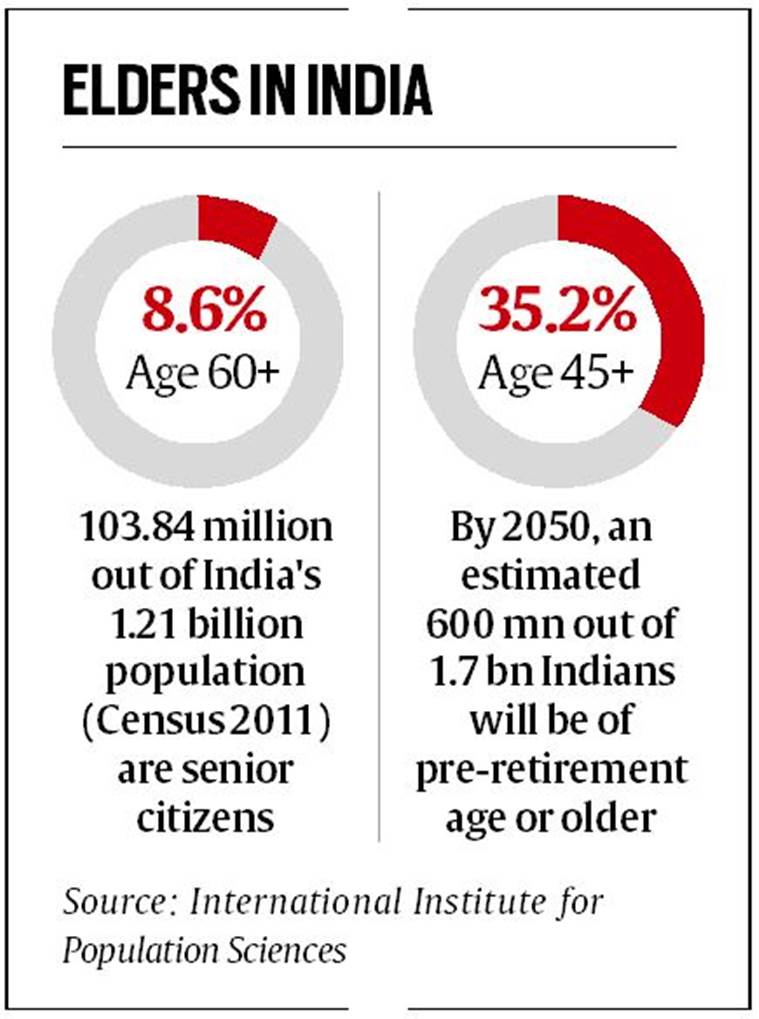
Around 15-18% of the current population will retire in 2040-50. This works out to about 23 cr Indians. Huge number. 

Image result for retirement planning india census 2011

Shorter working life and higher life expectancy 
On account of higher education, people are joining the work force later. This increases their earning capacity for sure but the earning lifespan is lower. A 70 yr old today may have worked for 40 yrs but his son will probably work for 30-35 yrs and his grandson will work for about 25 yrs. And life expectancy of the son is about 10 yrs more than the 70 yr old father and life expectancy of the grandson will probably be 15 yrs more. 

So key takeaway is longer life spans, higher earning capacity but lower earning years span.  So the importance of planning during those earning years is very important. If you spend and keep upgrading your lifestyle, and dont save enough in inflation beating assets, you are going to have a tough time in your old age. 

A recent podcast interview of Subramoney.com by Anupam Gupta titled The Retirement Timebomb is a good one to listen to. He makes some very important points and stresses on the need to start early. 

Start small but start early. But if only age could and youth would. 


Sunday, 3 February 2019

Retirement Planning and Target Date Funds

Last April I wrote a blog on snowballing your savings and how starting is important, however small it may be. And then I forgot all about it.

The passing of John Bogle rekindled my memory about this blog and this time I hope to go through with the series.

Underinvestment in financial assets
In an August 2017 report of a committee on household finance set up by the RBI revealed some statistics which make for a ticking time bomb for future retirees

  • Only 65% Indian households headed by person younger than 35 years hold any financial assets, the data from the RBI report shows
  • Only 5% Indians invest over 10% in financial assets

I am going to focus on the youth here because that the is segment I am most interested in. They are tech savvy, have time on their side and they are in the building phase of their financial savings habits.

Enough and more has been written about how Indians love gold and property. There are behavioral reasons for these. I have written about why we love to own homes here. Gold is gradually losing it luster as a jewellery consumption item but its benefit as a buffer is still there because of its ease to store and ease of buying. Plus buying a tangible good gives us psychological comfort.

However, it has been seen over long run, equities have beaten every asset class. While there are no guarantees, they still remain the best bet to beat other asset classes and beat inflation.

Image result for returns from gold equity real estate

National Pension Scheme
In India the government has introduced the National Pension Scheme (NPS) along with tax benefits. However the problem that I have with it is that the funds in which we invest are going to be actively managed by fund managers. Fund manager risk is something I cannot plan or guard against if i am going to save for the next 40 years.

I would rather put my faith in an Index fund with low cost and which is going to be managed by a set of predetermined rules. Btw we did a study of MF industry and the active funds didn't beat the index over a ten year period. The gap can be explained to a large extent by costs. (we will release that study soon).

We know what balanced funds are: A combination of debt and equity where the fund manager decides how much allocation has to be made to debt and how much to equity. And depending on his view on the market he keeps shifting the allocation. David Swensen, CIO of Yale's Endowment Fund says "asset allocation" explains over 90% of a portfolio's investment returns. The balance 10% could be because of fund managers, luck, skill etc. And post cost even that whittles away.

Now don't get me wrong, as humans we will always engage in a challenging endeavor. Now, I am an active fund manager but I believe for majority of the investing and saving population index funds are best.

Let us get to a special category of balanced funds called Target Date Funds. A target date fund (TDF) – also known as a lifecycle, dynamic-risk or age-based fund  designed to provide a simple investment solution through a portfolio whose asset allocation mix becomes more conservative as the target date (retirement) approaches. The figure below explains how.

Related image


So that's it for today. I am going to write the next part on how TDFs work, and how we can create or mimic TDF strategies in India till we get these specific fund types.


Wednesday, 12 September 2018

How a Sebi move to protect investors will put small PMS players at risk


How a Sebi move to protect investors will put small PMS players at risk
If the minimum ticket size for PMS investment is doubled to INR50 lakh, a number of players will have to either shut shop or move to an AIF model.
12 Sep 2018
Anish Teli, who runs QED Capital Advisors, a boutique portfolio-management service (PMS) based in Mumbai, has a fresh challenge to handle. The ticket size of his PMS is INR25 lakh and his new task centres around that. For, market regulator Securities and Exchange Board of India (Sebi) is considering an increase in the minimum ticket size for PMS investments from INR25 lakh to INR50 lakh.

Sebi has sought the views of the PMS industry in a meeting last week. So, last week when a working woman walked into his office, Teli knew she was perhaps one of the last investors to enter his scheme with INR25 lakh.

But what triggered the Sebi action? The following points sum it up:

§  PMS products are considered riskier than mutual funds as they invest in stocks of companies that have higher liquidity and business risks but give good returns.
§  The regulator feels that more retail investors are investing in PMS products without understanding the risk-reward ratio.
§  Also, it wants to restrict investors who may not have the risk appetite.

 No impact on big players 
The PMS business is targeted towards high-net-worth individuals (HNIs). A Credit Suisse report released in November 2017 states that India is home to 245,000 dollar millionaires. This number can touch 372,000 by 2022. These HNIs are professionals who want to diversify their equity holdings and look at PMS as a way out. This is the target client list that the PMS industry has set its sight on. Big PMS managers feel that the industry is constantly changing, and more and more Indians are becoming rich and they don’t mind a bigger ticket size.

The big players say they are getting enough money even on a higher ticket size. For them, INR50 lakh is not a hurdle at all. “You look at the average ticket size of the industry as of now — it is INR60 lakh. And we are talking of the top players here. So, people have already invested way above INR25 lakh or have multiplied their wealth in the existing PMS,” says the CEO of a large PMS company.

While the big PMS schemes such as ENAM and Old Bridge Capital have a minimum ticket size that is at or above INR1 crore, a bulk of the industry has a lower ticket size. The total number of players in the PMS business works out to be 255. Of this, only around 10 players ask for a ticket size that is bigger than INR25 lakh.

The top 20 funds account for 75% of the total assets in the PMS business and that is what worries the smaller players. They feel the PMS industry will go the mutual fund way, where seven funds account for 70% of the assets. And if the ticket size is increased, many of the new PMS managers will have to shut shop or go in for an alternative investment fund (AIF) licence.

Big blow for small schemes
“Smaller boutique firms, who want to follow their own investment style and stay small and nimble, will have to scale up fast or move to an AIF model,” Teli says.

Increasing the minimum investment amount from INR25 lakh will impact retail investors looking for customised solutions. It will make it very difficult for professional fund managers to enter the industry,” he adds.

He has a point. The PMS business has attracted the risk-taking clients, who already know about investing in equity. They know that equity is a risky bet and invest only a part of their wealth in PMS. “These people are smart. They have a high risk-taking ability. But to expand the market, it makes sense to lower the ticket size. I think there is a big market out there which has the ability to take risk,” says Arindam Chanda, executive director and head of broking business at IIFL.

Chanda feels that the move to increase the ticket size is cosmetic. The average ticket size for the industry as of now is around INR60 lakh. This is proof that most people have invested more than INR25 lakh in equities through PMS. But this market is limited. Today the total size of the PMS market is restricted at INR1.2 lakh crore and it can only expand if the restriction on minimum investment is lowered.

Most of the industry doesn’t understand why the regulator is in such a hurry to increase the limits. It was only in 2012 when PMS limits were increased from INR5 lakh to INR25 lakh.

Parag Parikh Financial Advisory Services ran a very successful PMS till 2012 at a ticket size of INR5 lakh. It was at a time when many players had increased their ticket size to INR20 lakh-INR1 crore. But Parag Parikh felt that it was his job to turn the middle class into a rich class. He knew that the middle class did not have the risk appetite to shell out more than INR5 lakh for investing in equities.

When he did not have an option but to increase the ticket size to INR25 lakh, he converted his PMS scheme into a mutual fund scheme so that he could stay true to his dream of increasing the net worth of the middle-class investor. But launching the scheme required a capital of INR50 crore. It was not an easy task, but he managed to sail through. The Parag Parikh long-term equity fund today has a size of INR1,352 crore and has given high risk-adjusted returns to its investors.


Sebi’s move to protect investors may put them at higher risk
The PMS industry invests in a part of the market where price discovery is not easy. By looking for good investment ideas in companies that are small and illiquid, they actually make the market efficient. If the ticket size of PMS is increased, these investors will move out of mutual funds (MFs) and try to take risks on their own. That would be even more dangerous as they will not have any professional help.

The MF industry is going through a lot of change. While it is getting around INR6,000 crore every month, the MF business has become competitive and distributors are earning less commission, compared to the last five years. Direct plans are becoming a reality and many of the distributors are now distributing PMS products. “Some are targeting investors in mutual funds with investments more than INR25 lakh. They are shifting that money to PMS funds, exposing the investor to higher risks,” says the CEO of a large PMS fund who doesn’t want to take new clients without understanding their risk profile.

The problem is that risk profiles keep changing. At this point, when the markets are on a high, the average investor is in a position to take higher risk. But the same investor, rich or middle-class, doesn’t want to be in the market when the market is falling.

A PMS fund manager who understands the needs of the client is actually an advisor to his investor. He looks at the asset allocation of the client and in most cases, onboards the client only if he has the ability to stay with the fund when markets fluctuate.

“Instead of looking at an absolute number, Sebi should look at the asset allocation of the client. Basically, a 50:50 ratio between equity and debt for clients at the INR25 lakh ticket size would be a better idea,” says a fund manager.

Anybody who puts in INR25 lakh in a PMS scheme understands the risk. Most of them have a net worth of INR5 crore, sometimes only in equities. “The regulator should get in more smart fund managers into the industry by thinking of expanding this market than restrict it,” says Aashish Sommaiyaa, CEO, Motilal Oswal AMC.

The bottom line
The regulator has noble intentions, but they can be detrimental to both the PMS industry and investors.

A person, who is earning INR20,000 a month is allowed to take high risks and invest in mutual funds without any professional advice. Then why should someone with a net worth of INR2 crore-INR5 crore be restricted from approaching the PMS route with the help of an advisor?

Also, with 75% of the PMS assets resting with bigger players, it will be difficult for smaller players to survive. These are mostly new players who have come into the market over the last four years after the bull run started. Now before the end of the bull run, they are in for a bigger challenge that was faced by the PMS industry in 2012. But this time, survival will be tough.


Sunday, 2 April 2017

Snowball your Savings

Snowball your Savings


“Stocks are the things to own over time. Productivity will increase and stocks will increase with it. There are only a few things you can do wrong. One is to buy or sell at the wrong time. Paying high fees is the other way to get killed. The best way to avoid both of these is to buy a low-cost index fund, and buy it over time. Be greedy when others are fearful, and fearful when others are greedy, but don’t think you can outsmart the market. “If a cross-section of American industry is going to do well over time, then why try to pick the little beauties and think you can do better? Very few people should be active investors.” - Warren E Buffett

Each sentence in the paragraph above is an investment tenet by itself. Lets break it down.
1.     Equities are the things to own over time. Productivity will increase and equities will increase with it. There are only a few things you can do wrong. One is to buy or sell at the wrong time.
2.     Paying high fees is the other way to get killed. The best way to avoid both of these is to buy a low-cost index fund, and buy it over time.
3.     Be greedy when others are fearful, and fearful when others are greedy, but don’t think you can outsmart the market.
4.     If a cross-section of American industry is going to do well over time, then why try to pick the little beauties and think you can do better? Very few people should be active investors

In simple terms, a snowball effect is a situation that increases in size or importance at a faster and faster rate.


Simply put: 
  • Very few people have the time and inclination to be full investors. And this is not something to dabble in over the weekend. Start accumulating low cost index funds early in your life and keep snowballing it regularly. 
  • Paying high fees means giving away snow from your snowball. Be careful. 
  • The crowds get fearful at bottoms and at tops. But no one, not even Buffett or Soros or Rakesh or your local fund manager can ring a bell at the PRECISE top or bottom. But you can approximately time the market via following some simple rules. It is boring and its slow. But you are not doing this for excitement or entertainment. 
  • Don’t be too cute and think that you can outsmart the market consistently over a long periods of time. If most retail investors were to even get market returns over a long time, they would end up far richer than trying to be extra smart. 


The market is like a haystack and everyone is looking for a golden needle in it. But if you could get access to a gold haystack then would you really waste time looking for a golden needle. There are lot of other things in life to focus on. Pick your share of gold hay and move on.    

To Be Continued.....


Monday, 6 February 2017

Day 21: Invest for a cause

And just like that I am on day 21. 

Today I am going to just talk about one point and that is please understand the difference between investing and speculating. Its not a simple trivial point. There are also no value judgements being cast about being a speculator. But unfortunately society tends to overrate investors and look down upon trader or speculators. 

Graham and Dodd many years ago said: Investment "is a convinient omnibus word, with perhaps an admixture of euphemism - i.e., a desire to lend a certain respectability to financial dealings of miscellaneous character."   

Investors provide long term patient capital and speculators provide short term liquidity and price discovery. We need both for markets to function efficiently. 

Warren Buffett is an investor and George Soros is a speculator. Both are very good at what they do and they are very successful at what they do. But they dont pretend to be what they are not. 


Warren Buffett offers a simple yet insightful take on this. Investment as Buffett explained: "And I say, the real test of how you - what you're doing is whether you care whether the markets are open. When I buy a stock, I don't care if they close the stock market tomorrow for a couple of years because I'm looking to the business - Coca Cola, or whatever it may be, to produce returns for me in the future from the business.” On speculation he said, "It's a tricky definition. You know, it's like pornography, and that famous quote on that". (Supreme Court Justice Potter Stewart famously wrote that, regarding whether something was pornography or not, that, "I know it when I see it.")


In short, Buffett basically argues that what separates and investor from a speculator is the intent of the person engaging in the transaction. However, upfront it is very difficult to provide a precise definition of both.


What is important is to know what your intent is: 
  • Do you care the about price every hour or do you look at price once a month or quarter and evaluate your portfolio. 
  • Do you buy because your friend is buying or are you buying because you understand the business and have done your homework. 
  • Do you intend to hold on to the investment for atleast a few years or are in only for the next few days or weeks.

If you are able to answer these simple questions upfront before buying then you would know what you are doing.

Given below are list of blogs which have received the maximum page views, so I assume they have resonated with a lot of people.
  1. Day 6 - Understanding Greed and Fear
  2. Day 18 - Buy a home beta!!
  3. Day 1 - Introducing "Behavior Gap"
  4. Day 11 : Understanding Greed and Fear: Herding Bias
  5. Day 19 - Mutual Fund - Index or Active Management
I have really enjoyed writing these blogs over the last twenty one days. I would be continuing to write on a weekly basis now. And I hope to be regular.

I would also like to say thank you to all the people who have contributed so far to my campaign for the Nudge Foundation. They are doing a wonderful job. I hope many of us come forward and support this cause.

You can contribute here: http://thenudge.ketto.org/anishpteli

Regards
Anish
QED Capital


Important Disclaimer: Please do not treat anything on my blog as investment advice. I do not provide any recommendations of any stocks or securities. Any stock mentioned may be merely by way of an example

Sunday, 5 February 2017

Day 20 - Buying stocks - If you must

Its a full time business. Not a hobby. But most people treat it like one. Remember, you never make money off a hobby, you only spend it. 

Stocks are have a very high internal correlation than any other asset class. For eg the correlation between Tata Motors and HDFC Bank will be much higher than steel and crude oil. So I personally think obsessing with stock picking is overrated. If you pick the right sector and get the direction of the stock market broadly, your job is done. Even if you get the market direction right and buy good stocks, you are done.  

However here are some guidelines from Security Analysis by Graham and Dodd.

There are three aspects to consider while constructing your stock portfolio
1. The value of a stock depends on what it can earn on the future.
2. Good common stocks are those which have shown a rising trend of earnings. 
2. Good stocks will prove sound and profitable investments. 

Now lets do a very simple exercise. We will see the returns of Nifty of the past 5 years. And then i randomly picked some stocks to represent each sector.

So we see above that nifty has given annual return of 10.4% for the last five years. Now recount all the events that the market has seen to get here. 
  1. Coal Scam and other UPA Scams 
  2. Modi elected in 2014 
  3. Three years of Raghuram Rajan
  4. Taper Tantrum in the US
  5. Ben Bernanke leaving and Yellen taking over
  6. Start of rate hikes in the US
  7. Greece crisis and talk of Grexit
  8. Oil price collapse by 75%
  9. Brexit
  10. Trump election


I picked Sun Pharma, Infy, HDFC Bank, Hindalco L&T and Zee to represent Pharma, IT, Banking, Materials, Industrials and Media. 


The return that this portfolio made is 16.5% which was a big surprise to me also. Inspite of having laggards like Infy, Hindalco and L&T  the portfolio has done quite well. This is not a recommendation but just an example. A real portfolio should have atleast 10 stocks but not more than 15. Over 15 there is diminishing return from adding more stocks.

The important thing is not in the stocks picked but holding them through the events that we have witnessed. Temperament trumps intelligence any day in the investment business. 

Buy and hold doesnt mean never sell. Even Warren Buffett evaluates his portfolio and sells losers or books profits in stocks he believes are over valued. But thats the tough part that most people dont focus on - When to sell ?

Regards
Anish

Important Disclaimer: Please do not treat anything on my blog as investment advice. I do not provide any recommendations of any stocks or securities. Any stock mentioned may be merely by way of an example


Saturday, 4 February 2017

Day 19 - Mutual Fund - Index or Active Management

Occam's razor ( "law of parsimony") is a problem-solving principle attributed to William of Ockham (c. 1287–1347), who was an English Franciscan friar, scholastic philosopher and theologian. The principle can be interpreted as stating Among competing hypotheses, the one with the fewest assumptions should be selected.


Picking mutual funds is perhaps even more difficult than picking stocks for me. You cant talk directly to fund managers to find out what they are like. So you have to evaluate the fund house, fund returns and a bunch of numbers. Basically you are picking the guy who is going make decisions for your money but you have very little knowledge about him. When picking stocks, there is a lot more information available about the promoter of the company, media interviews and the fact that they have been managing the company for a certain time frame. Here you dont know how much skin the fund manager has in the game. While recently there have been disclosures in India about fund manager investments and their salaries, it is still not enough.


And then most of them dont even end up getting average returns.


In the US mutual funds, the S&P Index vs Active Report June 2016 reported that:
  • Over the five-year period through June 30, 2016, 91.91% of large-cap managers, 87.87% of mid-cap managers, and 97.58% of small-cap managers lagged their respective benchmarks.
  • Similarly, over the 10-year investment horizon, 85.36% of large-cap managers, 91.27% of mid-cap managers, and 90.75% of small-cap managers failed to outperform on a relative basis
You can read the entire article here

The good news is that in India the numbers are better. But its still about 50:50 chance. A coin flip. And the edge will diminish as the market becomes more institutionalised. 

So by Occam Razor's principle, I would pick an Index MF or ETF for the average retail investor. Now make no mistake an Index ETF is sold as a passive investment. It is not. It is a very basic trend following system where a committee lays down a set of rules and criteria of including and excluding stocks in the index. Stocks which fulfil the criteria stay and those which fail, go. Similar to trend following where winners stay and losers go. Remember our friend: Disposition effect - Holding on to losers and cutting winners. An index and trend following strategy do the opposite.

You can read more on this topic here:


Another decision to make is whether one should make lumpsum investments or do an SIP. I would say do an SIP for your regular savings and if you do get a lumpsum windfall like a bonus or from sale of another investment, then invest that amount over 6-12 months and not immediately.


There is no need to have so many mutual fund schemes. There are perhaps more schemes than there are investible stocks in India. 

Regards
Anish


Friday, 3 February 2017

Day 18 - Buy a home beta!!

Upfront disclaimer: I may be suffering from a full blown case of confirmation bias and I may be looking only for information that suits my belief. So bear with me. 

Rent hai paraya, aur EMI hai hamara. Thats how homes are sold in India and world over. Playing on our primal instincts for shelter, this social construct is now an industry so large that the global economy can be bought down with it. 2008 is still fresh in our minds.

Germany is perhaps the only developed country where home ownership is not encouraged. Germany’s home ownership rate remains quite low at 43% in 2013 vs 66% for Britain in the same year and much higher in most other EU nations. The only populace that rents more than the Germans is the Swiss populace. And we all know that the Swiss and Germans are quite logical and rational albeit boring maybe.

You can read more here. Most Germans don’t buy their homes, they rent. Here’s why

The only reason one can perhaps buy a home if it is available at a reasonable price (as a thumbrule your house should not exceed 2-3 years of gross annual income at the time of purchase) is to use it as a piggy bank to save your surplus income. I doubt most homes in Mumbai would qualify. If you are not savvy enough to invest in equities and mutual funds, then perhaps a home is ok. But it would be stupid to buy one, especially at these rates, if you are a decently savvy and well informed investor.

Why It's Plain Stupid To Buy A House In India

A blog on this by well know finance advisor Subramoney : Should you buy real estate?

A table is worth a thousand words. So look at the post tax returns below. Assuming you can sell your property at will at the price you want, you would still make a much lower amount than equities and just as much as gold. 


But if you had bought Asian Paint shares versus a home, you would not have called people home for a Griha Pravesh and got some social rub off of owning a home. Imagine how the conversation would go: Your mother/father calls up your relatives and invites them home for a puja because 10,000 shares of Asian Paints are going to be credited to your demat account. So buying equity and mutual funds woudnt get you social prestige but it can make you rich if you are willing to postpone that gratification. 

The 14% of smart money that could exit between 2000 and 2013 has generated a mind boggling 2% IRR. And if the balance 86% smart money below could not exit, I doubt the average retail guy has much of a chance.


I may be completely wrong but thats my view. 

Next three days I will cover, picking mutual funds (which is even more difficult than picking stocks) and buying equity. 

Regards
Anish


Thursday, 2 February 2017

Day 17 - What chance does the small guy have ?


One of the biggest myths prevalent in the stock market is the small retail investor is at a significant disadvantage to the professional investor be it a mutual fund manager or hedge fund investor or HNI. However that is not the case.

Size: WB has famously said in 1999 in an interview to BusinessWeek: "Its is a huge advantage to not have a lot of money. If I was running $1 million today, or $10 million for that matter, I’d be fully invested. Anyone who says that size does not hurt investment performance is selling. The highest rates of return I’ve ever achieved were in the 1950s. I killed the Dow. You ought to see the numbers. But I was investing peanuts then. It’s a huge structural advantage not to have a lot of money. I think I could make you 50% a year on $1 million. No, I know I could. I guarantee that.”

Career risk: Keynes said that it is better for career prospects to fail conventionally than to suceed uncoventionally. If you take risk and it pays off, in a fund, you may still get fired for taking too much risk. No one will fire you for buying HDFC Bank but you may get fired for buying a risky bank which may still turn out to be right. However as a small investor you have no such risk because you are your own client.


Institutional imperative: When you work as a fund manager in a professional capacity, you are paid for activity. You need to come up with new ideas all the time and keep on meeting company management or researching an industry and be active for the sake of it. The biggest asset in investing in being able to think for yourself and calming your selves down in this day and age of noise. Man's biggest problems come from not being able to sit in a room quietly or in some cases keep their fingers from tweeting randomly. Investing is watching paint dry. Its very boring. If you sit by yourself and come up with 2-3 good ideas a year, you wont have have that job for long. 

So the next time you think the market is tilted in favor of the big guys, think again.

Regards
Anish

Wednesday, 1 February 2017

Day 16 Check Check Check Mate !!!


Mohnish Pabrai is a classic value investor in the tradition of Warren Buffett, Charlie Munger and Seth Klarman. He currently manages an approx $500 mn fund which is highly concentrated. In the great crash of 2008, his portfolio got decimated and had a huge drawdown. It compounded at negative 47% almost a year and half - 2008 and 2009. He attributes this to hubris as he didn't have negative returns even in 2000 during the dotcom crash. He says that he completely missed the housing bubble.

Pabrai then drew upon the idea of a checklist from a NYT article and read The Checklist Manifesto by Dr Atul Gawande. Dr Gawande got the idea from the aviation industry where checklists were used to lower the number of human errors. 


An excerpt from the article:

"In 2001 a critical-care specialist at Johns Hopkins Hospital decided to give it a try. He didn’t attempt to make the checklist cover everything; he designed it to tackle just one problem: line infections. He plotted out the steps to take in order to avoid infections when putting a line in. Doctors are supposed to (1) wash their hands with soap, (2) clean the patient’s skin with chlorhexidine antiseptic, (3) put sterile drapes over the entire patient, (4) wear a sterile mask, hat, gown, and gloves, and (5) put a sterile dressing over the catheter site once the line is in. Check, check, check, check, check. These steps are no-brainers; they have been known and taught for years. So it seemed silly to make a checklist just for them. Still, Pronovost asked the nurses in his I.C.U. to observe the doctors for a month as they put lines into patients, and record how often they completed each step. In more than a third of patients, they skipped at least one.

The next month, he and his team persuaded the hospital administration to authorize nurses to stop doctors if they saw them skipping a step on the checklist. This was revolutionary. The specialist and his colleagues monitored what happened for a year afterward. The results were so dramatic that they weren’t sure whether to believe them: the ten-day line-infection rate went from eleven per cent to zero."

Pabrai studied his own investing errors and asked the question as to were there factors which were clearly visible before the investment was made. In most cases where the investment went bad, he found that the factors were visible. He looked at his own portfolio as well the portfolio of investors like Warren Buffett etc. and studied their mistakes and if these mistakes were identifiable at the time the investment was made. He then came up with his check list which has about 97 questions.


He also talks to a like minded investor, who has no vested interest in the outcome, and runs him through his investing thesis. This is a good way to check confirmation bias.

So depending on whether you invest directly in equities or indirectly in mutual funds, you must have a written down checklist of factors that you must keep in mind while making any investing decision. We may think that we have covered all factors, but very often we miss a few often. 

I have my own checklist and I urge you all to make yours too. 

If you want help on making one, please email me and I shall be happy to help you with it. 

Regards
Anish

Tuesday, 31 January 2017

Day 15 - Mind it!!!

For the past 8 days I have gone on and on about biases and today I am going to tell you that while it difficult to overcome these biases, it is not impossible to reduce the effect that they have.

A famous behavioral finance professor carried out this experiment in her class. She asked all the students to write down the last two digits of their cell phone number on a piece of paper. And then she asked them to estimate the number of countries that are there in Africa. Then she collected all the papers and showed that those whose cell phone numbers were higher offered higher estimates. Then she did it again after telling the students that they had been warned. And the same result emerged again.

So what this tells us that just being aware of a bias is not enough to overcome it. We see it all the time in real world too. Cigarette warnings, fat content warnings on junk food, need to exercise et al. We know all of this but find it hard to follow them. Because we are humans. This is harmful to our physical health.

And the behavioural biases are harmful to our financial health but we still continue to be plagued by them.

The one way I have learnt to atleast move one step ahead of just knowing that I have a bias, is to figure out a way to pause between a thought/stimulus and action. Its called being mindful. Mindfulness is said to be a buddhist concept and has been made popular in the west by Jon Kabat-Zinn.


And the way to pause is to check yourself before acting on your thought and the best way to do it ....you guessed it...have a checklist of things to keep in mind before acting.

Mindfulness and use of checklists may perhaps be the single most concept that I can perhaps try and convey to all the readers. Being mindful and using checklists has not made me error free. I still make errors. But I make fewer errors and usually I dont make the same ones again.

Tomorrow more on checklists. Today lets pause and be mindful.

Regards
Anish
QED Capital

Monday, 30 January 2017

Day 14 - Putting the biases together


Today I am going to try and show you how these four biases which I have written about early impact each stage of decision making in investing. 

  • Confirmation Bias :The tendency to ignore information contradictory to prior beliefs or look for information confirming prior beliefs.
  • Herding : Also known as the “bandwagon effect,” herding is the tendency for individuals to mimic the actions of a larger group.
  • Anchoring Bias :The tendency to rely too heavily on the first piece of information received.
  • Disposition Effect: Investors tend to sell winners too early and hold on to losers too long.


The starting point for a retail investors starts off with a belief about which he/she has already made up his/her mind. And then they look for information to confirm that belief. They think they can understand or analyse the impact of demonetisation on the indian economy, Or the benefits of GST implementation or how inflation will impact the RBI's decision in the next credit policy and so on. 

At times the belief also stems from herding i.e. a colleague, friend or neighbour has "apparently" made a lot of money from that idea and you just cant be left behind.  

And they have the friendly business channels also to their rescue. If you close your eyes and try and listen for about 5 mins to what the anchors are saying something about the day's market movement, it will not amount to anything. That's 5 mins of your life you will never get back. (I have tried it). 

Investors also believe they will correctly able to assess the impact of all this on the earnings of a company, on the sector and then are able to also express this into a position i.e. buy or sell or hold. Most of the time its a buy. And once they get some information that supports their prior belief, they get heavily anchored to that. And even if by chance they get information to the contrary they will find it hard to disregard the earlier information. 

Now it is virtually impossible to get someone to consistently do all of the above. Not even Rakesh Jhunjhunwala or Warren Buffett will get all the time. Infact Steve Cohen has famously said that his best traders are right on a trade only 50%  of the time. So now where does that leave the average retail person. 

But with a high degree of confidence and ego invested, if the stock starts going south then disposition effect (tendency to hold on to losers) kicks in. One will tend to hold on to it even if the orignal investment belief is proven wrong and information is available to that effect. 


And if by chance, the stock goes up, then itchiness to sell the stock and book profit kicks in. Greed and ego wants to lock in the gains. 

However there is one place where one can get away with all this. Read the next two paras from an article by Barry Ritholz.

"In politics, you can get away with this. Voters live in bubbles of their own making -- the selective perception and confirmation bias through which they view the world. The penalty for fabricating your own reality, false though it might be, seems to be minimal or nonexistent in politics. Voters live with the consequences of the ballots they cast, though the effects may not be felt for years. Making up alternative facts about childhood vaccines, the unemployment rate, climate change or where your predecessor was born certainly hasn’t hurt Trump -- it may even have helped him win the election.

Investors, however, aren't quite so lucky when their belief systems diverge from reality. Mr. Market seems to take delight in taking money away from those whose capital is deployed based on a set of faulty convictions. This is why I harp on cognitive issues, the importance of understanding your own psychology and, most recently, not mixing politics with investing."

You can read the entire article here.

There are many other biases but these four are key. And today I will end here and from tomorrow we will move on to other aspects of investing like the nature of markets and how it is complex adaptive system which is never in equilibrium and then how trends are formed. 

Thank you too all of you for reading and supporting. You all know who you are. I really appreciate the support and encouragement. 

Regards
Anish


Sunday, 29 January 2017

Day 13 - Understanding Greed and Fear: Anchoring Bias

Anchoring Bias :The tendency to rely too heavily on the first piece of information received

Most vegetable vendors in Indian markets use this bias to great effect while bargaining with buyers. The first quote that they give is high but not so high so as to drive the buyer away. And then the negotiations anchor around the first quote. Sometimes the buyer will wear him down and sometimes they get the better of the buyer.


Even auction houses use this bias by setting a reference price or a reserve price. Given below is an example of a bid for a wine bottle. Both the bidders are first asked their social security number and then asked to bid for the bottle. Both give widely different bids, which are close to their social security number.


In the context of investing, this effect plays out when investors get anchored to their buy price. All their future decision making then is referenced around this buy price. And then this bias feeds into the Disposition effect that I wrote about here

Remember Disposition Effect is the effect to hold on to losers and sell winners early.  

And once price goes below the buy price, most investors will not sell it until is comes back to break even i.e. the buy price. Another way it plays out is when a stock falls from a recent high and buyers rush, anchoring their reference point to the recent high and think they are buying at a discount. 

Tomorrow we will tie up the key biases that I have written about.

You can read more about Anchoring Bias here 

Regards

Anish


Important Disclaimer: Please do not treat anything on my blog as investment advice. I do not provide any recommendations of any stocks or securities. Any stock mentioned may be merely by way of an example.